Your agents don’t know what your company knows.lore turns your decisions into canon they follow.
Decisions, policies, and standards live in your git, go through review like code, and are retrieved by your AI agents via MCP — before they write the first line.
---
type: decision
title: Every deployment is single-tenant
status: draft
---

Each knowledge base runs on the
customer’s infrastructure, isolated
from any other tenant. Git is the
single source of truth.Why now
Method and memory for the age of AI agents.
Most companies already use AI to write software — but without a formal process for it, and without a centralized knowledge base that tells agents what holds true in your company. The result is speed without direction. lore delivers both ready-made and built in: agents consult before acting, propose instead of deciding, and humans approve.
Less rework, lower cost
When every team — and every agent — rediscovers the rules on its own, the company pays for the same mistake several times over. With a single source of truth, a decision is written once and applies to everyone, and rework drops.
Knowledge stays with the company
Decisions that today live in a few people’s heads become permanent records. When someone leaves or changes teams, what the company learned stays accessible — to people and to agents.
AI with governance, not improvisation
Nothing becomes official truth without human approval, and every change is recorded with author, date, and reason. Your company speeds up with AI without giving up control and auditability.
The roles
From product to code — and back.
Every role writes to the same book. The Product Owner records intent, architecture records the boundaries — and the developer’s agent consumes both before writing the first line, feeding back what it learned.
Product Owner
Intent becomes a record
PRDs and domain language become typed records — versioned and retrievable by agents, instead of lost in slides and tickets.
Architecture
The standard becomes a gate
Standards and architecture decisions get published once and apply to everyone. The agent retrieves the boundary before it violates it — not after, in code review.
Development
The agent closes the loop
Day to day with Claude Code, the agent pulls the PRD and the standard via MCP, writes within them — and feeds back what it learned as a proposal, which only becomes canon with human review.
› implement one-click checkout

lore · search "checkout payment"
  ↳ prd/one-click-checkout.md
  ↳ standard/payments-via-gateway.md

code written within the standard…

lore · propose "PSP requires a recurring-payment token"
  ↳ draft → pull request → review
Convergence
Many agents converge on one canon.
Every team, every agent, retrieves from and proposes against the same git. Knowledge converges on a single canonical source, reviewed by humans — and everyone starts from it, not from silos.
How it works
Canonical in git. Reviewed by humans. Consumed by agents.
The agent is the interface. lore doesn’t add a new system of record — it makes the system you already trust, git, retrievable by agents, while keeping humans in control of what’s canonical.
- 01
Git is canonical
Every record is a typed markdown file in the Open Knowledge Format (OKF), the open specification published by Google Cloud — versioned in your git repository. Nothing writes knowledge straight to a database, and nothing locks you in: your files stay readable by any tool.
- 02
Humans hold the review gate
Draft records become canonical through a pull request, reviewed like code. No record becomes canonical without human approval.
- 03
Agents consume via MCP
Your agents search, read, and propose knowledge through an MCP server — retrieving the right ADRs, policies, and assumptions before acting, not after.
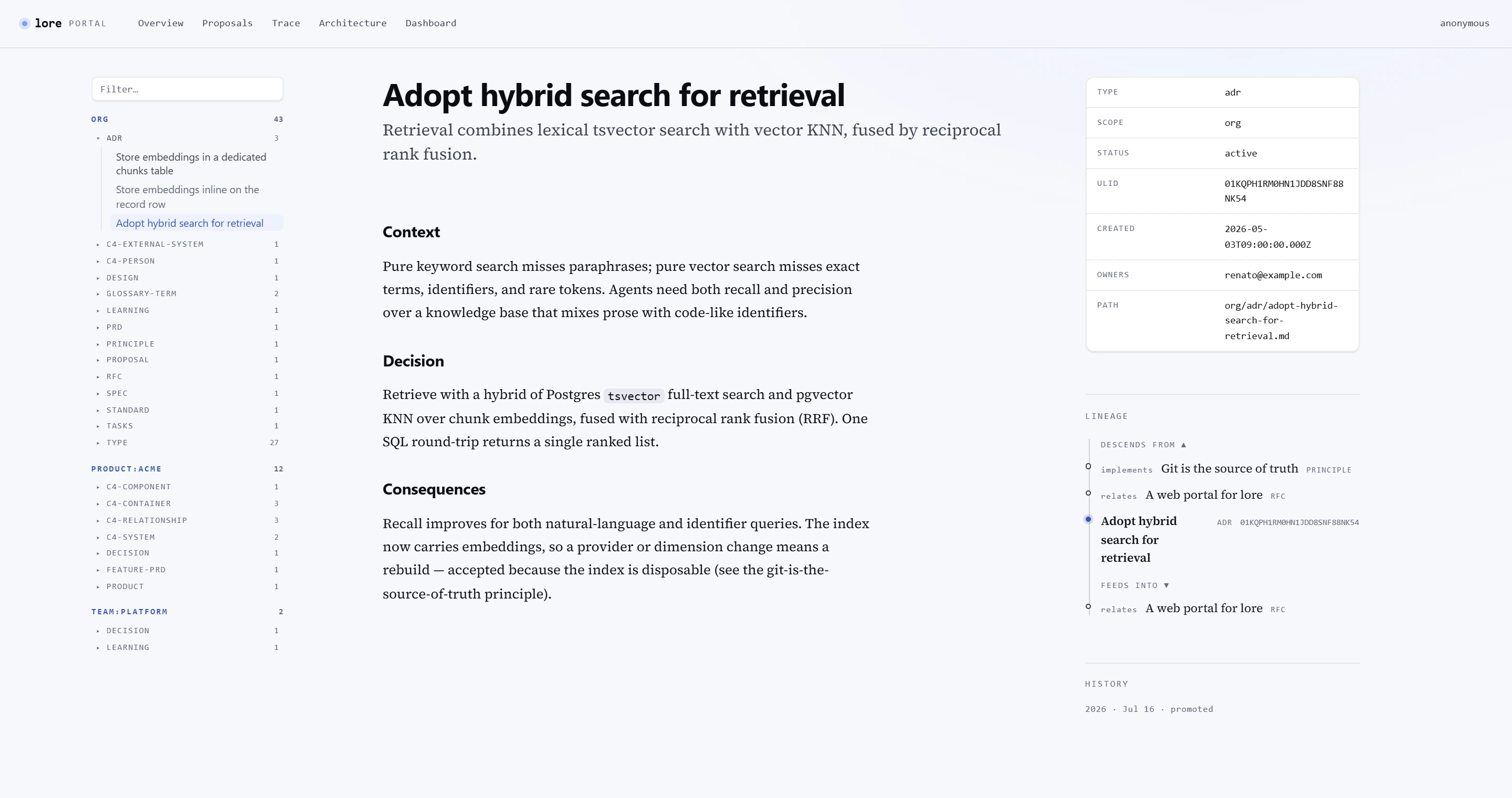
Onboarding is installing the plugin and signing in via SSO — nothing to stand up or maintain.
The front door
A knowledge base by Friday.
Your organization already has years of implicit knowledge inside its own code — READMEs, ADR folders, OpenAPI specs, commit history. Point the harvester at your repositories, review the pull requests, and ship a populated knowledge base this week instead of starting from a blank page.
Deterministic
Existing ADRs, OpenAPI specs, README structure, CODEOWNERS, infrastructure as code.
Heuristic
Wiki exports, documentation trees, and commit messages that reference decisions.
Semantic
An LLM pass infers capabilities, processes, glossary terms, and implicit decisions from code and docs.
Every candidate carries provenance and becomes a draft pull request — it never goes straight to canonical.
Security & enterprise
Built for a company that already has a security team.
lore deploys inside your perimeter and speaks the protocols your platform team already trusts.
SSO / STS integration
OAuth 2.1 and OIDC against your existing identity provider (reference implementation with Keycloak). lore never stores credentials.
On-prem, single-tenant
Every deployment is single-tenant by default — your knowledge base runs on your infrastructure, isolated from any other customer.
Git-native audit trail
Every proposal, review, and promotion is a commit and a pull request. The audit trail is the same one your engineers already use for code.

Early access
Bring canonical knowledge to your agents.
We’re selecting a small number of engineering teams building with AI agents. Tell us a bit about yours.
Or talk to us directly: [email protected]